Hermeto Pascoal (born June 22, 1936) is a Brazilian composer and multi-instrumentalist. He was born in Lagoa da Canoa, Alagoas, Brazil. Pascoal is a legendary figure in the history of Brazilian music, mainly known for his abilities in orchestration and improvisation, as well as being a record producer and contributor to many Brazilian and international albums. Pascoal comes from northeastern Brazil, an area that lacked electricity at the time he was born. He learned the accordion from his father and practised for hours indoors as, being albino, he was incapable of working in the fields with the rest of his family.
Hermeto’s career began in 1964 with appearances on several Brazilian recordings alongside relatively unknown groups. These now-classic albums and the musicians involved (Edu Lobo, Elis Regina, Cesar Camargo Mariano) established widely influential new directions in post-bossa novaBrazilian jazz.
In 1966, he played in the Sambrasa Trio, with Airto Moreira and Humberto Clayber; they released only one album, Em Som Maior. Then he joined Trio Novo (Airto Moreira, Heraldo do Monte, Theo de Barros) and in 1967 the group, renamed Quarteto Novo, released an album that launched the careers of Pascoal and Moreira. Pascoal would then go on to join the multi-faceted group Brazilian Octopus.
The first independent label to dedicate itself exclusively to Brazilian instrumental music. Legitimizing independence in the studio was the goal behind the dream of the couple Walter Santos and Teresa Souza, owners of Nosso Estúdio. A serious response to the authoritative “hunches” of producers in the 1980s. The couple stood out for the artist’s freedom in his creation. The choice of instruments, arrangers and duration of the track were promptly attended to provide a favorable environment for the musician. ((Portuguese version).. http://armazemmemoria.com.br/som-da-gente/
Meeting with Rodolfo Nanni, Brazilian filmmaker, meet the 8.02.1988
Rodolfo Nanni was born in São Paulo in 1924, the son of Italian parents from the Farnese region. In his early youth, he had a close relationship with the sculptor Victor Brecheret, who was his first cousin and had his studio on the grounds of Rodolfo’s parents’ house. Consequently, he also lived with Mário de Andrade, Oswald de Andrade, Tarsila do Amaral, Menotti del Picchia, Di Cavalcanti and other artists of Brazilian modernism.
Rodolfo started his studies in plastic arts in 1943, first in Brazil with Anita Malfatti, Candido Portinari and Axl Leskosceck and later, in Paris, with Arpad Zsenès. In the French capital, in 1948, he started Cinema Studies at IDHEC – Institut des Hautes Études Cinematographiques, where he stayed until 1950. https://pt.wikipedia.org/wiki/Rodolfo_Nanni
meeting with the most important landscape architect Burle Marx on February 26, 1988 in his house in the village of Guaratiba near Rio de Janeiro, 4 June 1994 – unfortunately deceased..
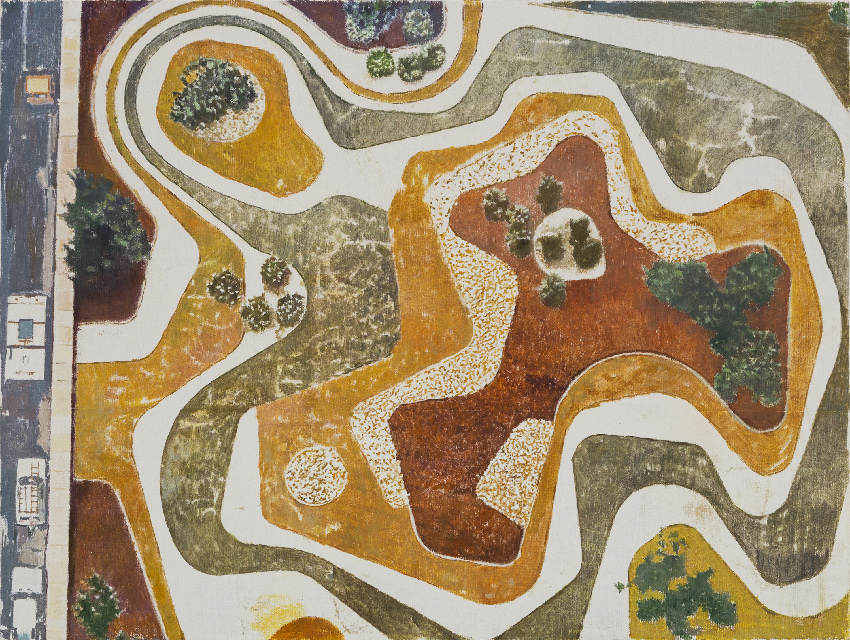
Roberto Burle Marx (August 4, 1909 – June 4, 1994) was a Brazilian landscape architect (as well as a painter, print maker, ecologist, naturalist, artist and musician) whose designs of parks and gardens made him world-famous. He is accredited with having introduced modernistlandscape architecture to Brazil. He was known as a modern nature artist and a public urban space designer. His work had a great influence on tropical garden design in the 20th century. Water gardens were a popular theme in his work. He was deftly able to transfer traditional artistic expressions such as graphic design, tapestry and folk art into his landscape designs. He also designed fabrics, jewellery and stage sets.
He was one of the first people to call for the conservation of Brazil’s rainforests. More than 50 plants bear his name. He amassed a substantial collection of plants at his home, including more than 500 philodendrons.
In 1932, Burle Marx designed his first landscape for a private residence by the architects Lucio Costa and Gregori Warchavchik. This project, the Schwartz house was the beginning of a collaboration with Costa which was enriched later by Oscar Niemeyer who designed the Brazilian Pavilion at the New York World’s Fair in 1939. Niemeyer also designed the Pampulha complex in 1942 for which Marx designed gardens. His first garden design was completed in 1933. In 1937, Burle Marx gained international recognition and admiration for this abstract design of a roof garden for the Ministry of Education building. The design highlighted elements of tension and drama.
In 1949 he acquired the Sítio de Santo Antonio da Bica, a 365,000m² estate in the Barra de Guaratiba neighborhood on the outskirts of Rio de Janeiro. Burle Marx began taking expeditions into the Brazilian rain forest with botanists, landscape architects, architects and other researchers to gather plant specimens. He learned to practice studying plants in situ from the botanist Henrique Lahmeyer de Mello Barreto and established his garden, nursery and tropical plant collection at Guaratiba. This property was donated to the Brazilian government in 1985 and became a national monument. Now called Sítio Roberto Burle Marx, under the direction of IPHAN-Instituto do Patrimônio Histórico e Artístico Nacional / Ministério da Cultura, it houses over 3,500 species of plants. The house was rebuilt in a valley on the site of a garden house belonging to the original plantation estate.
Roberto Burle Marx founded a landscape studio in 1955 and in the same year he founded a landscape company, called Burle Marx & Cia. Ltda. He opened an office in Caracas, Venezuela in 1956 and started working with architects Jose Tabacow and Haruyoshi Ono in 1968. Marx worked on commissions thorough out Brazil, Argentina, in Chile and many other South American countries, France, South Africa, Washington D.C. and Los Angeles. Additionally his artwork can be found displayed throughout the city of Rio de Janeiro “it is an open-air museum of works displaying his unmistakable style, one wholly his own” (Montero 2001 p. 29). Roberto Burle Marx’s 62-year career ended when he died June 4, 1994 two months before his 85th birthday.
He spent time in the Brazilian forests where he was able to study and explore. Burle Marx was one of the first Brazilians to speak out against deforestation. This enabled him to add significantly to the botanical sciences, by discovering new rocks and plants for example. At least 50 plants bear his name. Marx was also involved in efforts to protect and conserve the rain forest from the destructive commercial activities of deforestation for bananas and other crops and clear cutting of timber.
O laboratório de experimentações botânicas e paisagísticas que sintetiza a obra de Burle Marx é a 23ª obra brasileira a integrar a Lista do Patrimônio Mundial
Unusual encounter from my trip to Brazil the 26.01.1988 I one of the greatest world architect: ## OSCAR NIEMEYER ## friends of Le Corbusier, met in his office in Ipanema – Rio de Janeiro I 5 December 2012 – unfortunately deceased..
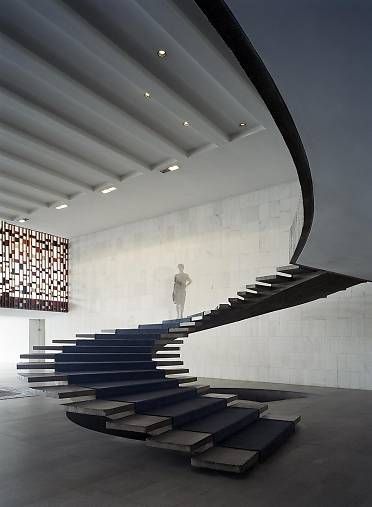
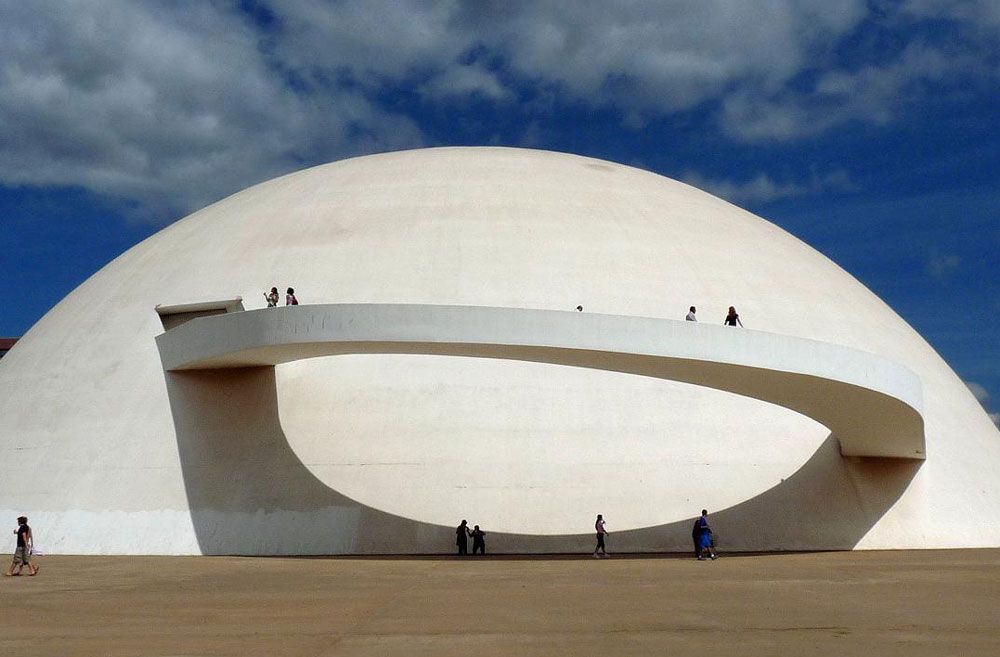
Oscar Ribeiro de Almeida Niemeyer Soares Filho (December 15, 1907 – December 5, 2012), known as Oscar Niemeyer (Brazilian Portuguese: was a Brazilian architect considered to be one of the key figures in the development of modern architecture. Niemeyer was best known for his design of civic buildings for Brasília, a planned city that became Brazil’s capital in 1960, as well as his collaboration with other architects on the headquarters of the United Nations in New York. His exploration of the aesthetic possibilities of reinforced concrete was highly influential in the late 20th and early 21st centuries.
Both lauded and criticized for being a “sculptor of monuments”,Niemeyer was hailed as a great artist and one of the greatest architects of his generation by his supporters. He said his architecture was strongly influenced by Le Corbusier, but in an interview, assured that this “didn’t prevent [his] architecture from going in a different direction”. Niemeyer was most famous for his use of abstract forms and curves an wrote in his memoirs.
Early career…
After graduating, he worked in his father’s typography house. Even though he was not financially stable, he insisted on working in the architecture studio of Lúcio Costa, Gregori Warchavchik and Carlos Leão, even though they could not pay him. Niemeyer joined them as a draftsman, an art that he mastered (Corbusier himself would later compliment Niemeyer’s ‘beautiful perspectives’[10]). The contact with Costa would be extremely important to Niemeyer’s maturation. Costa, after an initial flirtation with the Neocolonial movement, realized that the advances of the International Style in Europe were the way forward for architecture. His writings on the insights that could unite Brazil’s traditional colonial architecture (such as that in Olinda) with modernist principles would be the basis of the architecture that he and his contemporaries, such as Affonso Eduardo Reidy, would later realize.
In 1936, at 29, Lúcio Costa was appointed by Education Minister Gustavo Capanema to design the new headquarters of the Ministry of Education and Health in Rio de Janeiro. Costa himself, although open to change, was unsure of how to proceed. He assembled a group of young architects (Carlos Leão, Affonso Eduardo Reidy, Jorge Moreira and Ernani Vasconcellos) to design the building. He also insisted that Le Corbusier himself should be invited as a consultant. Though Niemeyer was not initially part of the team, Costa agreed to accept him after Niemeyer insisted. During the period of Le Corbusier’s stay in Rio, he was appointed to help the master with his drafts, which allowed him a close contact with the Swiss. After his departure, Niemeyer’s significant changes to Corbusier’s scheme impressed Costa, who allowed him to progressively take charge of the project, of which he assumed leadership in 1939.







 Art * Music* Architecture * Sciences * Cinema * Theater * Cirque * Forain *